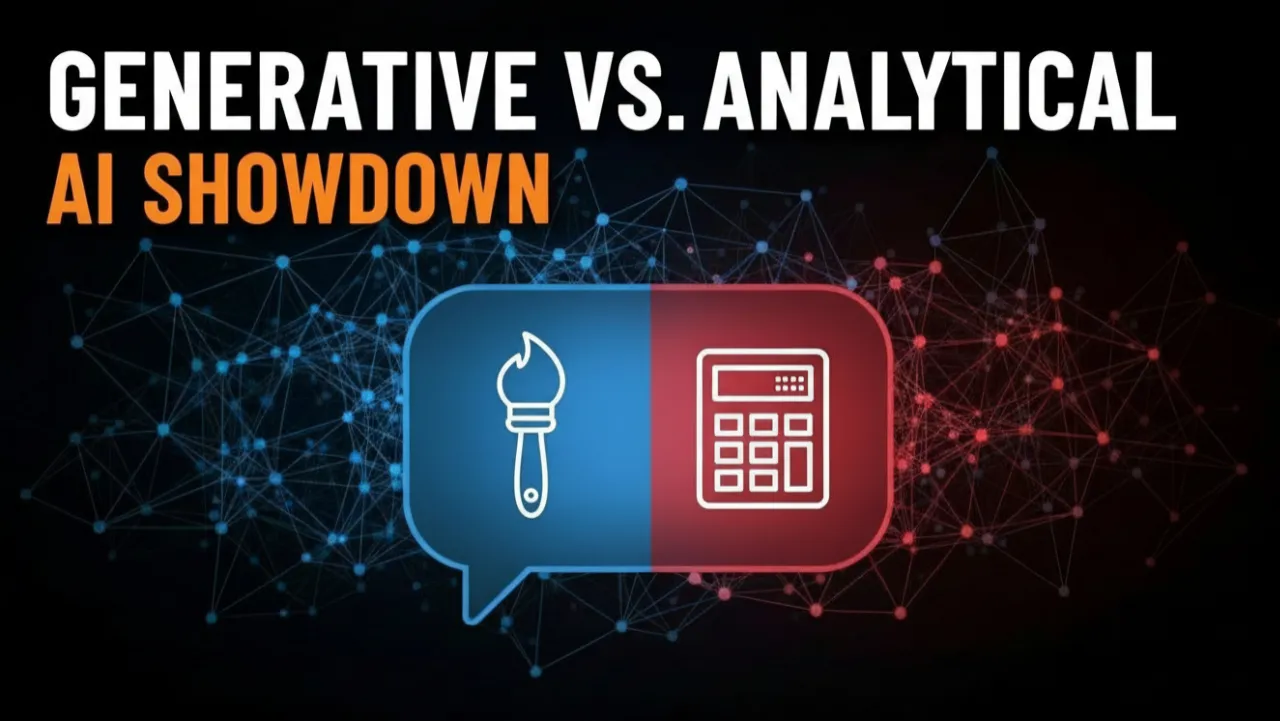
Generative AI vs Analytical AI

Generative AI vs Analytical AI: Key Differences and Uses

Decodes Future
August 8, 2025
15 min

Introduction

Artificial intelligence (AI) has rapidly evolved from a futuristic concept to a transformative force reshaping industries, economies, and human experiences. From predictive analytics in finance to content generation in media, AI now encompasses a broad spectrum of capabilities that mirror, and in some cases surpass, aspects of human cognition. Among the various branches of AI, two distinct modalities have emerged as dominant paradigms: Generative AI and Analytical AI.

While both types of AI leverage data and machine learning to perform tasks that once required human intelligence, their goals and mechanisms differ profoundly. Generative AI focuses on creativity, producing new, original content such as text, music, images, or even software code. Analytical AI, by contrast, concentrates on understanding, dissecting and interpreting data to reveal patterns, make predictions, and guide decision-making.

The purpose of this article is to elucidate the key differences and complementary strengths of these two AI modalities. We will explore their definitions, characteristics, real-world applications, and ethical considerations, ultimately illustrating how generative and analytical AI are jointly shaping the next frontier of technological innovation.


What is Generative AI?

Generative AI represents the creative frontier of machine intelligence. Rather than merely processing or classifying existing data, generative models are designed to produce new, previously unseen content based on learned patterns from vast datasets. This technology doesn’t simply replicate, it imagines, synthesizes, and composes.

1.1 Characteristics

At its core, generative AI relies on complex neural network architectures, particularly Generative Adversarial Networks (GANs), Variational Autoencoders (VAEs), and transformer-based models such as GPT (Generative Pre-trained Transformer). These systems learn underlying data structures and can then generate fresh outputs that adhere to the same statistical characteristics.

The hallmark characteristics of generative AI include:

  • Creativity and Originality: Generative models can produce text, images, videos, and sounds that did not exist before. For instance, GPT models generate human-like text responses, while DALL-E produces entirely new images from textual prompts.
  • Pattern Learning: These models identify and internalize deep contextual relationships within massive datasets. For example, a text-based generative model learns grammar, tone, and semantics to craft coherent paragraphs.
  • Probabilistic Reasoning: Generative AI uses probability distributions to predict what new data might look like, ensuring its outputs are both plausible and varied.
  • Adaptive Learning: Through continual training, generative systems refine their outputs based on feedback, improving realism and coherence over time.

1.2 Applications

Generative AI has transitioned from experimental labs to mainstream applications across industries. Key domains include:

  • Content Creation and Media: Platforms use models like GPT, Claude, and Gemini to write articles, create video scripts, or generate captions automatically. Tools like DALL-E, Midjourney, and Stable Diffusion empower artists and designers to generate visuals that once required manual labor or artistic expertise.
  • Personalized Marketing: Generative AI enables hyper-personalized email campaigns, ad copy, and imagery tailored to individual consumer preferences, enhancing engagement and conversion rates.
  • Software Development: AI coding assistants such as GitHub Copilot and Replit Ghostwriter generate code snippets and help developers debug or optimize code in real-time.
  • Healthcare: Emerging generative models simulate molecular structures and create synthetic medical data to augment limited datasets for research while preserving patient privacy.
  • Education and Training: AI tutors can generate lesson plans, quizzes, or interactive learning simulations dynamically based on a student’s progress.
  • Design and Architecture: Designers use generative AI for 3D modeling, architectural layouts, and product design exploration.

Generative AI’s creative potential is vast, democratizing innovation and enabling users to express ideas at a scale and speed once unimaginable.


What is Analytical AI?

Analytical AI, sometimes referred to as predictive or descriptive AI, represents the reasoning and diagnostic counterpart to generative AI. Its primary purpose is to analyze existing data, uncover insights, and forecast outcomes. This form of AI is the backbone of data-driven decision-making across sectors like finance, logistics, healthcare, and governance.

2.1 Characteristics

Analytical AI thrives on data interpretation rather than creation. It relies on statistical models, machine learning algorithms, and deep learning techniques to process and make sense of structured or unstructured datasets.

The defining traits of analytical AI include:

  • Data-Driven Insight: Analytical AI transforms raw data into actionable intelligence by identifying patterns, anomalies, and correlations.
  • Predictive Modeling: Using regression models, decision trees, or neural networks, analytical AI forecasts future trends, behaviors, or risks based on historical data.
  • Optimization and Efficiency: It enhances operations by recommending the most efficient routes, resource allocations, or business strategies.
  • Explainability and Traceability: Analytical AI often prioritizes interpretability, enabling humans to understand why a model produced a certain prediction, a crucial aspect in regulated industries like finance and healthcare.
  • Reactive and Diagnostic Nature: Unlike generative models that create outputs proactively, analytical systems react to data inputs to diagnose issues or optimize performance.

2.2 Applications

Analytical AI is deeply embedded in business and scientific processes. Notable applications include:

  • Finance: Banks and financial institutions use analytical AI for fraud detection, credit scoring, algorithmic trading, and risk assessment. By analyzing transaction data, it predicts suspicious activities or market movements.
  • Healthcare: Analytical models analyze patient records, imaging data, and genomics to predict disease progression, personalize treatments, and enhance diagnostic accuracy.
  • Supply Chain Management: From predicting demand to optimizing logistics, analytical AI ensures efficiency and resilience in global supply networks.
  • Retail and Marketing: Predictive analytics guide inventory management, pricing strategies, and customer retention campaigns by forecasting buying behaviors.
  • Manufacturing: Analytical AI supports predictive maintenance by identifying when machines are likely to fail, reducing downtime and costs.
  • Public Policy and Governance: Governments leverage analytical AI to interpret population trends, manage resources, and detect tax or benefits fraud.

In essence, analytical AI is the strategic engine that converts the raw material of data into intelligent, evidence-based decisions.


Key Differences Between Generative AI and Analytical AI

Though they share foundational machine learning principles, generative and analytical AI diverge in purpose, method, and outcome. Understanding these distinctions is crucial for deploying each technology effectively.

3.1 Objectives

The objective of generative AI is *creation*. It seeks to emulate human-like creativity by producing new content, be it visual art, text, or design concepts. Its aim is innovation through synthesis.

In contrast, the objective of analytical AI is *comprehension*. It aims to extract meaning and predictive insights from existing data. Analytical AI focuses on accuracy, reliability, and optimization rather than originality.

Thus, while generative AI answers the question “What can we create?”, analytical AI addresses “What can we understand or predict?”.

3.2 Techniques Employed

The technical underpinnings of the two modalities also differ:

  • Generative AI employs deep generative models such as GANs, transformers, and autoencoders. These models learn to approximate the distribution of input data and generate new samples from that distribution.
  • Analytical AI, on the other hand, uses supervised and unsupervised learning algorithms, such as regression analysis, decision trees, clustering, and time-series analysis. These methods identify relationships and patterns to make sense of data rather than create from it.

Generative AI often relies on unsupervised or semi-supervised learning, learning patterns without explicit labels. Analytical AI typically depends on supervised learning, where models learn from labeled datasets to predict outcomes.

3.3 Output Types

The outputs of generative and analytical AI are fundamentally distinct:

  • Generative AI Outputs: New content such as text, art, designs, code, or even virtual environments. These outputs are expressive and often subjective in nature.
  • Analytical AI Outputs: Insights, forecasts, classifications, or numerical predictions derived from data analysis. These are objective, quantifiable, and decision-oriented.

For example, a generative AI might create an original advertisement visual, while an analytical AI system determines which demographic that ad should target for maximum engagement.


Implications and Future Trends

The convergence of generative and analytical AI heralds profound societal and technological transformations. Their interplay is shaping a future where intelligence is not only reactive but also creative.

4.1 Ethical Considerations

As AI systems gain influence, ethical challenges have become central to the discussion.

For Generative AI:

The creation of synthetic media raises concerns over authenticity, copyright, and misinformation. Deepfakes, hyper-realistic fabricated videos, can erode public trust and manipulate perception. Additionally, generative models trained on copyrighted materials challenge traditional notions of ownership and authorship. There are also questions of data bias: if training data reflects social inequities, generative AI may reproduce or amplify these biases in its outputs.

For Analytical AI:

Analytical systems face issues of algorithmic bias and fairness. Predictive models can inadvertently perpetuate discrimination in hiring, lending, or law enforcement if their training data contains historical biases. Transparency and accountability are equally vital, organizations must ensure explainability and ethical governance in how AI-driven insights influence decisions.

Addressing these challenges requires a combination of regulatory oversight, ethical AI frameworks, and responsible data governance to ensure AI benefits society without undermining human values.

4.2 Technological Evolution

The next frontier lies in hybrid AI systems that integrate both generative and analytical capabilities. These models will not only interpret complex data but also generate intelligent, adaptive responses.

For instance, in healthcare, a hybrid system could analyze patient data (analytical AI) and generate personalized treatment plans or medical imagery (generative AI). In finance, it could assess market trends and automatically generate investment strategies. Such synergy could lead to autonomous cognitive systems capable of continuous learning, creativity, and reasoning.

Other emerging trends include:

  • Edge and Federated AI: Decentralized systems that bring AI computation closer to data sources, enhancing privacy and efficiency.
  • Explainable Generative Models: Future versions of generative AI will incorporate transparency layers to clarify how outputs are formed.
  • AI-Augmented Collaboration: Generative AI tools integrated into productivity platforms will assist professionals in real time, from brainstorming ideas to data visualization.

As technology evolves, the distinction between generative and analytical AI may blur, giving rise to adaptive intelligence, systems capable of both deep reasoning and creative synthesis.


Conclusion

The evolution of artificial intelligence has bifurcated into two powerful streams, generative and analytical AI, each serving a unique but complementary purpose. Generative AI, with its ability to create new and imaginative outputs, is redefining creativity and human expression. Analytical AI, grounded in precision and insight, continues to power decision-making and predictive analytics across sectors.

While their objectives differ, one driven by creation, the other by comprehension, together they form the dual pillars of modern AI innovation. Understanding their distinctions allows organizations and individuals to harness their respective strengths strategically: using analytical AI to understand the world as it is, and generative AI to envision the world as it could be.

As ethical frameworks mature and hybrid systems evolve, these two modalities will increasingly converge, transforming industries and redefining human potential. The future of AI lies not in choosing between generation and analysis, but in fusing both to achieve a holistic, intelligent continuum, one that empowers creativity, drives progress, and reimagines the boundaries of human ingenuity.


Frequently Asked Questions (FAQ)

Is ChatGPT an analytical AI?

No, ChatGPT is a prime example of generative AI. It is built on a transformer-based Large Language Model (LLM) designed to generate new, human-like text based on the input it receives. It creates content rather than analyzing existing data for insights, which is the function of analytical AI.

What is the main difference between AI and generative AI?

Artificial Intelligence (AI) is a broad field encompassing any technique that enables computers to mimic human intelligence. Generative AI is a specific subset of AI that focuses on creating new, original content (like text, images, or music) that did not exist before. Therefore, all generative AI is AI, but not all AI is generative. Other types of AI include analytical, predictive, and reactive machines.

What is the difference between predictive analytics and generative AI?

Predictive analytics uses historical data to forecast future outcomes, answering the question, "What is likely to happen?" It is a type of analytical AI. Generative AI, on the other hand, uses learned patterns from data to create entirely new content, answering the prompt, "Create something new based on this." While predictive analytics forecasts from data, generative AI creates from data.

How do gen AI and analytical AI differ, and when to use each?

Use Analytical AI when your goal is to understand data, identify trends, and make informed decisions based on existing information. It's best for tasks like fraud detection, sales forecasting, and market analysis. Use Generative AI when your goal is to create new content, brainstorm ideas, or automate creative tasks. It's ideal for writing articles, designing graphics, composing music, or developing code.

Share this article

Related Articles

Continue exploring the future

Loading comments...