Introduction
The AI world is growing fast. Experts think the agentic AI market will grow from $4.3 billion to over $100 billion by 2034. But there is a hard truth: most AI projects fail. They do not reach their goals or work in the real world.
Table of Contents
Many projects will be stopped by 2027. This is because they try to solve problems that do not exist. This is called agent-washing. Companies just rebrand basic bots as smart agents to follow the trend.
True agentic AI is not just a chat box. It is an autonomous digital employee. It can look at a situation, pick a step, and keep working until it hits a goal. To build something that works, you must focus on the problem first. Pick a business challenge before you pick the tech. This is key for AI search visibility where being useful is what matters most.
The Core Philosophy: Problem-First vs. Model-First
A model-first approach starts with the tool: How can we use GPT-4o? This often leads to brittle demos that look impressive in controlled settings but break easily when faced with the unpredictability of production environments. When teams skip deep problem definition, they often build agents that solve the wrong tasks, resulting in high costs with negligible business impact.
In contrast, a problem-first approach begins by asking: Where is our $2M annually in inefficiency? It identifies high-volume, repetitive processes such as password resets that consume 70% of a support team’s time and then determines if agentic AI is the most effective solution.
The Orchestrator Shift
This requires a fundamental shift from coder to orchestrator. In this new paradigm, the developer’s role moves from writing static, deterministic logic to designing blueprints and modular constructs that guide goal-oriented AI agents through dynamic, multi-domain problems. Mastering this transition is a key step in LLM integration.
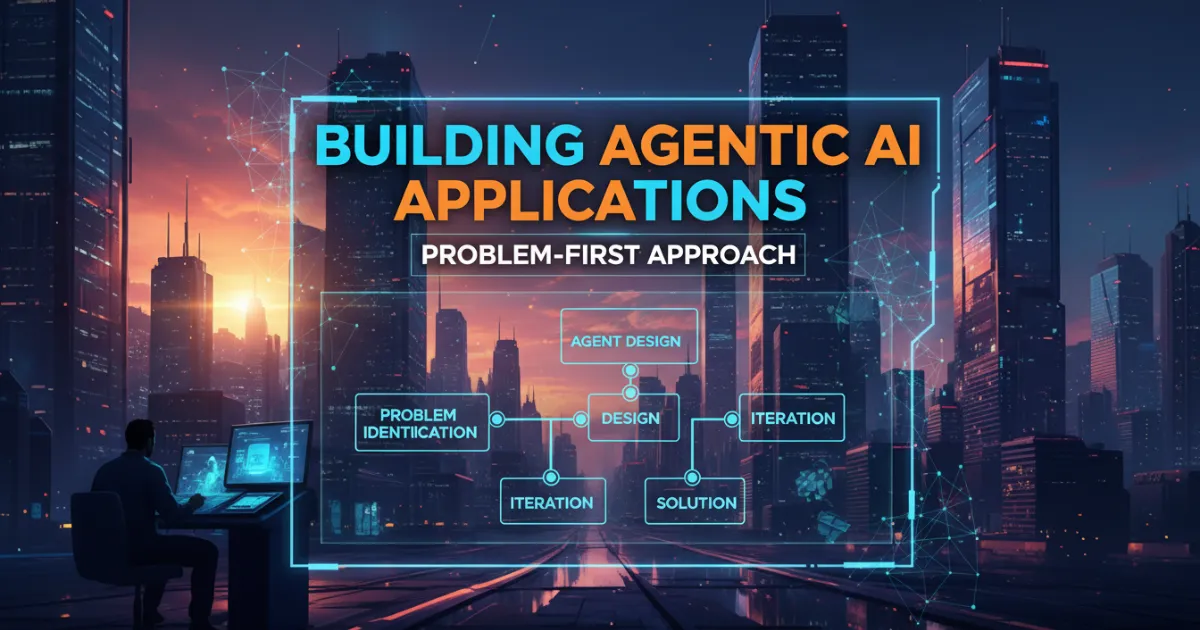
The 5-Step Problem-First Framework for Agentic AI
Step 1: Defining the PEAS
Building a reliable agent requires mapping exactly what the system sees and does. This includes Sensors for perception (collecting instructions and document feeds), the Environment (databases and APIs), Actuators for taking action (updating a CRM or triggering a script), and Performance metrics for the internal reasoning loop.
Step 2: Boundary Setting & Success Metrics
Organizations must define Done and establish clear decision boundaries. Success should be measured across technical performance, user experience, and business impact. Critically, boundaries must specify where the agent is allowed to fail or where it must escalate to a human.
Step 3: Selecting Minimum Viable Autonomy
Not every task requires complex reasoning. Developers must choose between Reflex Agents for simple, predictable scenarios and Goal-Based Agents for multi-step tasks where the AI decides how to reach a goal. Understanding the difference between generative and analytical AI is crucial when deciding where reasoning is actually utilized.
Step 4: Designing the Reasoning Engine
Choosing a framework should be based on the task, not the trend. LangGraph is ideal for graph-based planning, while Microsoft AutoGen excels at multi-agent coordination. Systems like CrewAI are designed for role-based structures, often requiring advanced prompt engineering to maintain consistency.
Step 5: Human-in-the-Loop Architecture
Total autonomy is often a liability. A robust architecture includes mandatory checkpoints where humans approve critical actions. This ensures accountability while letting the AI manage routine, low-risk work independently.
Technical Implementation: Moving to Architecture
Perception Layer
This layer handles how the AI hears and sees data. It pulls out the main goals and times from raw info. This is like how networking works in Xcode-based AI apps.
Reasoning Engine
This manages the logic and memory. Unlike a simple call, it keeps track of what happened. This stops the agent from making the same mistake twice.
Action Executor
This links the agent to real software. It must have save points. This stops the system from leaving things in a broken state if something goes wrong.
Reliability & The Evals First Mindset
To build a reliable system, developers must adopt an evals first mindset, building test cases before writing a single line of agent logic. Success metrics for agents require behavioral testing to see if the AI plans correctly and handles failures gracefully.
A high-performing agent should be grounded in a golden set of failure cases derived from live historical data. This evaluator loop uses one model to critique the output of another, promoting self-reflection and iterative optimization. For deep customization, consider training an LLM on your own data to ensure the model aligns with your unique business rules.
Common Pitfalls in Agentic AI Development
Over-Engineering
Adding unnecessary memory layers or multi-agent orchestration when a simple script would suffice leads to high latency and costs.
The Set and Forget Fallacy
Assuming agents run perfectly forever is a risk. Systems experience behavioral drift as datasets or usage patterns evolve.
Security Risks
Autonomous execution creates new attack vectors like prompt injection, where malicious inputs bypass access controls. This is why some wonder if AI will replace cybersecurity jobs or simply redefine the defense perimeter.
Lack of HITL
Failing to include human-in-the-loop checkpoints in high-stakes workflows can lead to catastrophic goal misalignment.
Case Studies: Problem-First in Action
Enterprise Compliance automation
Banks use agents to check if they are following rules. These systems find slow spots. They can speed things up by 3 times and save a lot of money.
Customer Service Execution
Companies like Klarna use agents to handle returns. They manage millions of chats every month. They do the work of hundreds of support staff.
Frequently Asked Questions
Does a problem-first approach take longer than building a demo?
Initially, yes. While a sandbox prototype may take 1-4 weeks, a production-ready rollout requires 3-6 months. However, this drastically reduces the Time to ROI by avoiding unpredictable behavior.
Can I use this approach with low-code platforms?
Absolutely. The philosophy is platform-agnostic. Whether using LangGraph or a visual builder, the steps of defining PEAS and success metrics remain identical.
When should I choose a Multi-Agent System over a single agent?
Only when a problem can be logically decomposed into specialized roles. If a single agent can handle the logic, a MAS adds unnecessary latency and cost.
"In the era of agentic AI, complexity must be earned, not accidental. Success lies in viewing AI as an integrated system of people and processes designed to solve the sharpest problems first."
CodeHaider